Why RDAs Aren’t Enough During Pregnancy (and How to Choose a Better Prenatal)
By: Kerry Lett, MPH, RDN, LDN, CLC

Disclaimer: This post is sponsored by Needed. However, this does not influence our opinions or recommendations.
Prenatal vitamins are often positioned as a simple checkbox in pregnancy care: pick one, take it daily, and assume your nutritional needs are covered. In reality, pregnancy, postpartum, and breastfeeding are some of the most nutrient-demanding stages of life and many parents remain depleted, even while taking a prenatal.
The Reality of Nutrient Depletion in Motherhood
Many women enter pregnancy already undernourished, often without realizing it (1). Busy lives, ongoing stress, restrictive eating patterns, digestive issues, and years of prioritizing others often lead to depleted nutrient stores long before conception. This depletion doesn’t always show up as a clear deficiency on a lab report. Instead, it may appear as symptoms that are frequently dismissed as “normal”:
Daily fatigue
Brain fog or poor concentration
Hair shedding
Mood changes or irritability
Low resilience to stress
During pregnancy, many nutrient needs increase and it can be hard to meet these increased needs through diet alone, even with a nutrient-dense diet. National health data shows that even women who take supplements are commonly low in key nutrients, such as vitamins A, B6, D, E, and K, along with choline, calcium, magnesium, iron, and zinc (1,2). These nutrients aren’t optional extras that are nice to have. They are foundational for hormone production, immune function, blood pressure regulation, and fetal brain and cognitive development*.
This gap between intake and true need is where RDAs come into focus.
What Are the RDAs and What Do They Actually Represent
Most prenatal vitamins will list the “Percent Daily Value” on the supplement facts label and you may have looked at this and felt reassured when you scanned and saw that your prenatal vitamin meets 100% of your daily value. However, most prenatal vitamins are less comprehensive than they may seem and the Dietary Reference Intakes (DRIs) and Recommended Dietary Allowances (RDAs) used to establish these percentages can be misleading.
It is important to keep in mind that the RDAs were designed to answer a very specific question: “What is the minimum amount of a nutrient needed to prevent deficiency in most people?” They are not designed to define optimal intake or support nutrient repletion for ideal nutrition. Even more importantly, pregnant and breastfeeding women were excluded from 83% of the studies used to establish current DRIs and RDAs (3). As a result, many standards still rely on research primarily conducted on white men with an incremental value added to account for pregnancy and lactation (3,4). This approach assumes maternal needs increase only modestly, which may significantly understate the true requirements. In fact, multiple research studies suggest that maternal needs for certain nutrients may be three to even ten times higher than the current pregnancy RDAs (5,6,7).
Why Most Prenatal Vitamins Fall Short
Most conventional prenatal vitamins are built to meet outdated benchmarks (such as the RDAs) rather than real-world needs, which often causes them to:
Provide bare minimum amounts intended to avoid deficiency, not support optimal health
Use nutrient forms with limited absorption and combine nutrients that compete for absorption, such as iron and calcium
Skip nutrients that are crucial to maternal and fetal health, such as choline
Fail to accurately account for increased nutrient demands during pregnancy, postpartum, and breastfeeding, such as iodine and zinc
From a clinical perspective, this often means pregnant and breastfeeding women continue to experience symptoms of depletion despite “doing everything right.”
Rethinking How You Choose a Prenatal
Rather than asking, “Does this prenatal meet the RDA?” or “What is the Daily Value on the back of this prenatal?” A more helpful question is: “Is this prenatal designed using current research to support nutrient repletion and increased demand during pregnancy and lactation?” That is a big question, but thankfully this is what some newer-generation prenatals are asking as they create their supplements.
Where Needed Fits In
Needed is one prenatal I frequently recommend in practice. The recent reformulation of Needed Prenatal Multi now provides 8x more nutrition than leading prenatals and 5x more nutrition than the outdated RDAs**.
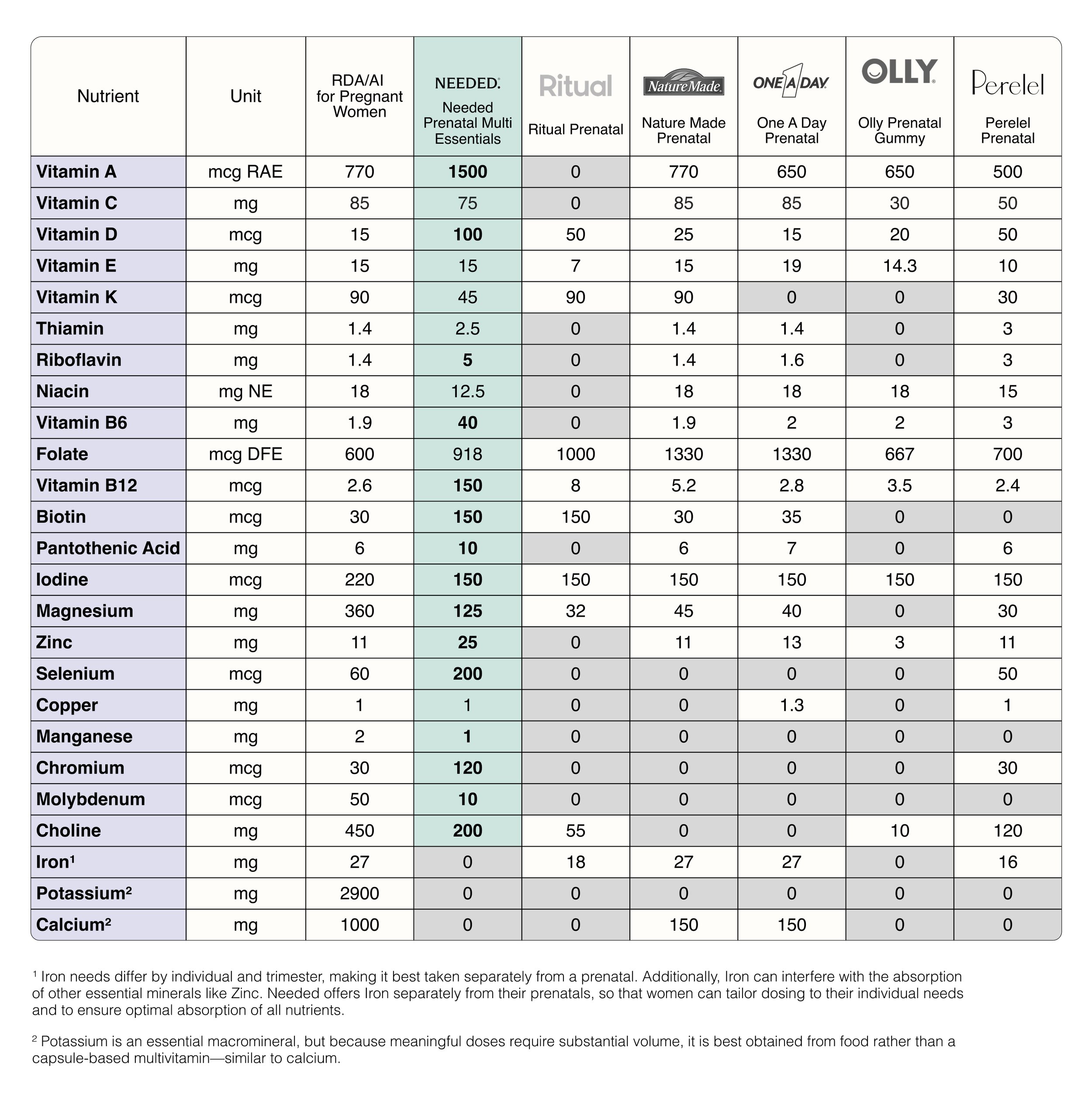
When thinking about what to look for in a prenatal, this prenatal is checking all of the boxes:
✔ Third-party testing for quality & purity and their dosing is clinically studied to overcome the nutritional depletion that many moms experience
✔ Bioavailable forms of vitamins
✔ Comprehensive nutrients, including:
40 mg of vitamin B6 to support neurologic function and commonly used to help with occasional morning sickness*
4,000 IU of vitamin D3, a dose more consistent with addressing one of the most common nutrient insufficiencies (8)
25 mg of zinc to support immune function and cellular growth*
200 mg of choline, helping to close a well-documented gap in prenatal nutrition (9)
✔ Calcium or iron, but not both as their supplement contains calcium, since iron supplementation is best when customized based on your lab work
Takeaway
Prenatal vitamins are not meant to be a perfect solution. They are tools designed to support a nutrient-dense diet, not replace it. Understanding RDAs helps explain why many prenatals fall short and why symptoms of depletion are so common during pregnancy and postpartum. Looking beyond minimums when choosing a prenatal allows you and your baby to receive more optimal nutrient support for the physiological changes and increased demands of motherhood. As always, the best prenatal is the one that aligns with your needs, is well tolerated, and fits into a broader plan for nourishment across the motherhood years.
If you’d like individualized support for your nutrition during pregnancy, schedule a discovery call today.
Disclaimer: This information contained in this blog is based on the experience of the author and science-based research. It is not intended to replace medical advice or diagnosis from a physician or other medical provider. This blog is not intended as a substitute for a consultation with a physician or other healthcare provider. The author is not responsible for any adverse effects or consequences resulting from the use of any suggestions discussed in this blog. This post is sponsored by Needed, a brand I genuinely recommend to my patients and use personally.
*These statements have not been evaluated by the Food and Drug Administration. This product is not intended to diagnose, treat, cure, or prevent any disease.
**Based on the Recommended Dietary Allowances compared to leading prenatals as determined by IRI $ sales data, 9/2024-9/2025.

Last medically reviewed on January 22, 2026
Kerry Lett, MPH, RDN, LDN,CLC is the pediatric & maternal registered dietitian and owner of Milestones Pediatric & Maternal Nutrition in Cary, NC. Kerry is passionate about helping growing families navigate life and achieve all of their milestones along the way. Schedule an appointment today.